Packing liquids is rarely difficult because of the rule itself. The awkward part is deciding what counts at the last minute: a half-used sunscreen in a 6 oz bottle, a regular toothpaste tube, an unmarked refillable face wash bottle, or a duty free perfume that has to pass another security checkpoint during a connection. As a safe baseline, most carry-on liquids should be in containers of 3.4 ounces or 100 milliliters or less, and the size printed on the container matters more than the amount left inside.
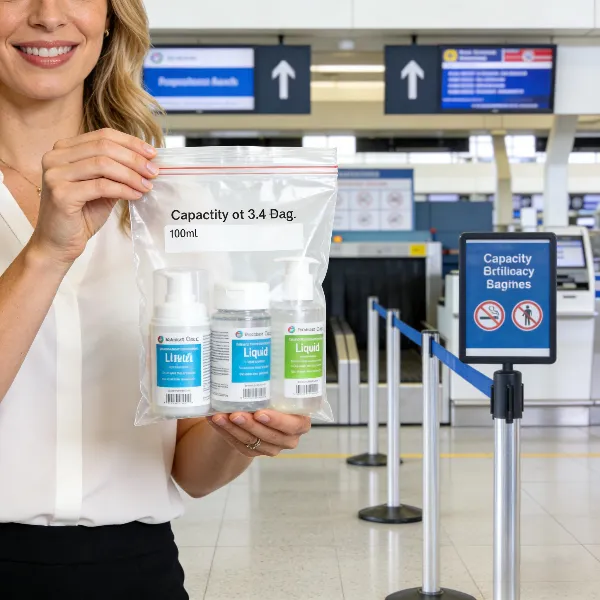
The useful question is not only “what is the liquid limit?” It is whether each item belongs in the clear bag, checked luggage, a separate screening pouch, or outside the bag completely.
Carry On Liquid Rules That Actually Matter at Security
Carry-on liquid rules become easier once the bag is checked by situation rather than by product category. A bathroom item, a makeup item, a snack, and a medical item can all need different handling. The first filter is simple: container size, clear bag space, and whether the item behaves like a liquid, gel, cream, paste, spray, or spread.
Use 3.4 oz or 100 ml containers
A 50 ml perfume bottle, a 75 ml sunscreen tube, or a 100 ml face wash is usually straightforward. The label is visible, the size is clear, and the item can go into the liquid bag without much judgment.
Products grabbed from the bathroom shelf are less reliable. A full-size shampoo, a 150 ml sunscreen, a 200 ml lotion, or a large mouthwash bottle may fit inside a carry-on, but that does not make it a good carry-on liquid.
For a short trip, the clear bag should not become a miniature bathroom cabinet. Toothpaste, deodorant, sunscreen, one face product, and one small cream usually deserve the space. Full-size shampoo, conditioner, body lotion, extra hair products, and backup skincare usually belong in checked luggage, at the destination, or out of the bag.
Check bottle size not remaining liquid
A half-empty bottle is one of the most misleading liquid items. A 6 oz lotion bottle with a small amount left at the bottom is still a 6 oz container. The leftover amount does not make the bottle compliant.
Sunscreen is the classic example. After a previous trip, the bottle may feel light enough to carry, but the printed size still matters. The same applies to shampoo, mouthwash, body lotion, hair gel, and face wash.
Decide this before leaving home. If the printed size is larger than 3.4 oz or 100 ml, transfer the product into a smaller labeled bottle, pack the original in checked luggage, or leave it behind. Hoping that a partly used bottle looks small enough is not a reliable plan.
Fit small liquids in one clear bag
A clear bag should close without effort. Once the zipper has to be forced, the bag is already too full. A packed-tight bag is harder to inspect, easier to tear, and more likely to leak inside the carry-on.
A useful check is to lay the bag flat. If the bottles sit in a loose layer and the contents are easy to see, the setup is usually fine. If the bag turns into a round bundle of caps and plastic, something should come out.
Give the space to items needed before hotel check-in or during the first day. Extra skincare, backup perfume, spare lotion, and full-size “just in case” products usually do not earn their place in the liquid bag.
Carry On Liquid Rules by Country and Airport
Liquid screening is usually decided by the departure airport and local security rules, not only by the airline on the ticket. Airline baggage pages are still useful for cabin bag size, weight, and checked luggage allowance. The liquid decision, however, usually happens at airport security.
Rules can change by country, airport, and screening system, so it is always worth checking the official guidance for your departure airport before flying. The TSA liquid rule, the European Commission air traveller guidance, and the UK hand luggage liquid rules are good official starting points.
This matters most on international routes, return flights, and connections. A relaxed rule at one airport does not always help at the next checkpoint. When a route includes more than one airport security check, the safest packing standard is still small, clearly labeled containers.
| Departure area or situation | Common carry-on liquid rule | Practical packing choice |
|---|---|---|
| United States TSA airports | Liquids, aerosols, gels, creams, and pastes are usually limited to 3.4 oz or 100 ml per container in one quart-size bag. | Use labeled small containers and avoid half-empty oversized bottles. |
| European Union airports | Liquids are usually limited to 100 ml per container in one transparent resealable plastic bag with a maximum capacity of 1 litre. | Keep medicines, baby food, and duty free liquids separate and easy to show. |
| UK airports | Rules depend on the departure airport. At most UK airports, containers over 100 ml are still not allowed through security, even if partly full. | Check the airport you fly from, any transfer airport, and the return airport. When unclear, follow the 100 ml rule. |
| International connections | The next security checkpoint may apply a different liquid rule from the first airport. | Keep duty free liquids sealed and avoid opening airport purchases before the final stop. |
| Checked luggage | The carry-on 3.4 oz or 100 ml limit usually does not apply the same way to checked bags. | Check full-size toiletries when possible, but avoid restricted, flammable, or hazardous products. |
The safest packing choice is not the most exciting one: carry small labeled containers through security and keep larger toiletries out of the carry-on when checked luggage is available. This avoids depending on a rule that may not apply at the return airport or transfer checkpoint.
Liquids That Are Easy to Miss Before a Flight
Drinks are easy to notice. The missed items are usually the ones that feel ordinary: toothpaste, lip gloss, sunscreen, cream makeup, hair gel, soft cheese, sauce packets, and squeeze pouches. These items create problems because they do not look like the main liquid issue during packing.
Check toothpaste sunscreen and face wash
Toothpaste is one of the easiest items to forget. A regular tube may look small in a bathroom drawer, but it still counts as a paste. If the tube is larger than 3.4 oz or 100 ml, it is a poor carry-on choice.
Sunscreen needs a practical decision. For a beach trip, a tiny bottle may not be enough. For a carry-on only trip, a small tube plus a sunscreen stick often works better than forcing a full-size bottle into the clear bag. With checked luggage, the full-size bottle usually belongs there.
Face wash follows the same logic. A small labeled bottle is fine. A full-size pump bottle is not worth the carry-on space. If it is only needed at the hotel, it does not need to pass through security in the cabin bag.
Pack creams gels and aerosols as liquids
Cream makeup, liquid foundation, mascara, lip gloss, nail polish, hair gel, shaving cream, spray deodorant, and hairspray all need a liquid-bag check. These items often get scattered across a makeup pouch, toiletry kit, purse, and backpack pocket, which makes them easy to miss.
Before packing, put every squeeze, spray, gel, cream, paste, and liquid on the counter. It is much easier to see what belongs in the clear bag once everything is in one place.
Solid versions reduce pressure quickly. Solid deodorant, bar soap, powder makeup, balm products, and shampoo bars can replace several liquid items. Aerosols need extra caution because some sprays may be restricted for safety reasons even when the can is small.
Treat spreadable snacks as liquids
Food can be the surprise problem. Peanut butter, jam, jelly, yogurt, hummus, soft cheese, dips, sauces, and squeeze pouches may be treated like liquids, gels, or spreads. A sealed jar still behaves like a spread.
Dry snacks are easier. Granola bars, crackers, nuts, cookies, dry cereal, and simple sandwiches create fewer problems than tubs, jars, sauces, and soft dips.
A quick food test helps: if it pours, spreads, squeezes, smears, or needs a spoon because it is soft, pack it like a liquid. If it is dry and solid, it is usually the simpler carry-on snack.
Larger Liquids That Need Separate Screening
Some larger liquids are allowed because they serve a specific need, but they should not be hidden in the regular toiletry bag. These items are easier to handle when separated before the checkpoint and kept with labels, receipts, or supporting information.
Take out liquid medicine early
Liquid medicine and medically necessary liquids are different from ordinary toiletries. The mistake is packing them under clothes or mixed with shampoo and lotion, where they look like random oversized liquids.
Original packaging helps. Prescription labels, product names, and readable dosage information make the item easier to understand. Documentation can also help with unusual, large, or important medical liquids.
Pack these items in a small medical pouch separate from the regular quart bag. It should be easy to remove without unpacking the carry-on. If cooling packs are needed, keep them with the medicine so the whole set can be checked together.
Separate baby formula breast milk and toddler drinks
Baby formula, breast milk, toddler drinks, and baby or toddler food are not ordinary toiletries. At TSA checkpoints, these items may be allowed in larger amounts and do not need to fit inside the regular quart-size liquid bag. At other airports, similar exceptions may apply, but they should still be separated and presented clearly at screening.
Avoid spreading bottles, pouches, snacks, spoons, and cooling packs across different compartments. Use one easy-to-open feeding pouch with related liquids and cooling items together.
Access matters more than perfect suitcase organization. If the pouch can be removed quickly, the rest of the carry-on can stay packed.
Keep duty free liquids sealed in the original bag
Duty free liquids are most risky during connections. Perfume, liquor, cosmetics, and skincare bought after security can still become a problem if another checkpoint screens the bag later.
Keep the item in the original sealed tamper-evident bag with the receipt available. Opening the bag before the final airport can weaken the case for carrying an oversized liquid through another checkpoint.
A sealed duty free bag helps, but it does not guarantee that every transfer checkpoint will accept the item. If the bag looks opened or damaged, the receipt is missing, or the item cannot be screened, it may still be refused.
Direct flights are simpler. Connections need more caution. If there is a transfer, duty free liquids should stay sealed until the last airport, not opened on the plane or during the layover.
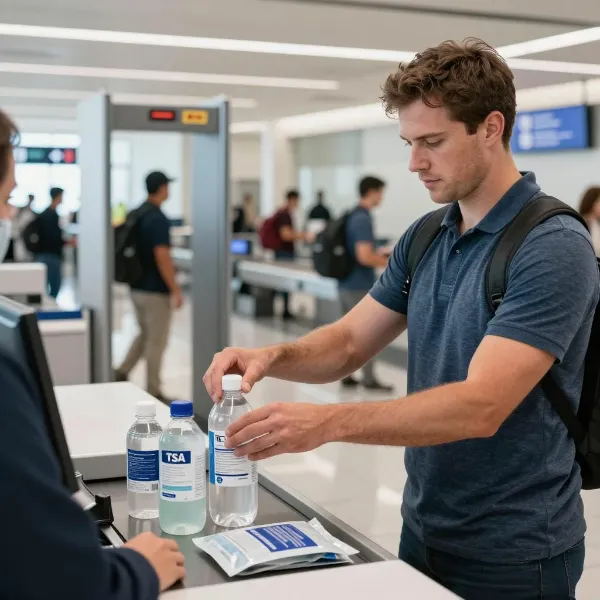
How to Pack Liquids for Air Travel Without Delays
A good liquid bag is not a tiny version of the bathroom cabinet. It is a checkpoint tool. Its job is to make the contents easy to see, easy to remove, and easy to understand if something needs a closer look.
Use containers with readable size labels
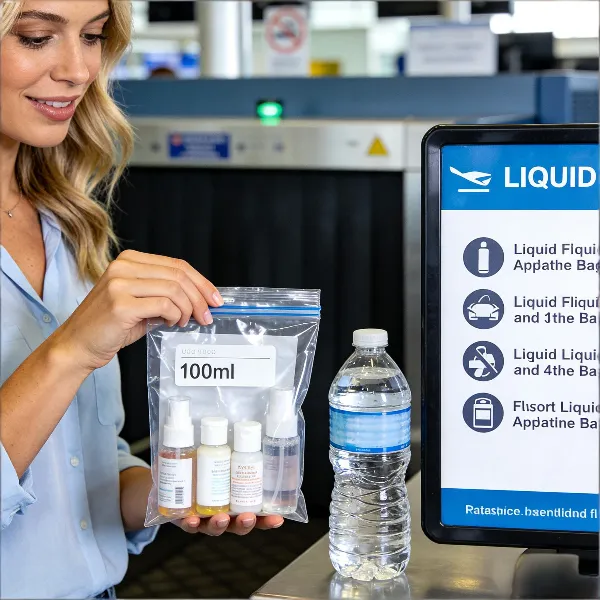
Bottles with readable size labels create fewer questions. A 100 ml face wash, a 75 ml sunscreen, and a 50 ml perfume bottle are easy to understand at a glance. Blank silicone bottles may be convenient at home, but they are weaker at security.
Refilled bottles work better when labeled with both size and product name. “Face wash,” “conditioner,” or “lotion” is clearer than several identical bottles with different liquids inside.
Keep the setup simple: readable size, clear product name, tight cap, no sticky residue, and no leaking. A messy bottle inside a clear bag makes the whole bag look harder to inspect.
Leave space in the clear bag
A clear bag that barely closes usually means too much has been packed. The goal is not to fit the maximum number of bottles. The goal is to avoid leaks, delays, and last-minute decisions at the tray.
A stronger liquid bag has fewer items with clearer purpose. Toothpaste for the first night, sunscreen for arrival day, deodorant, one essential skincare product, and one small fragrance or medicine item may be enough for many trips.
When the bag is full, remove duplicates first. Backup lotion, extra hair products, a second perfume, large mouthwash, and full skincare routines usually belong somewhere else.
Keep the liquid bag easy to remove
The clear bag should sit near the top of the carry-on. Burying it under clothes, chargers, shoes, or snacks turns a small inspection into a full unpacking job.
A final pocket check before the security line is worth doing. Lip gloss in a jacket, hand sanitizer on a keychain, eye drops in a purse, mini perfume in a side pocket, and spray deodorant in a gym pouch are easy to miss.
The neatest suitcase does not always move fastest through security. The fastest bag is the one with liquids grouped, labeled, and easy to reach.
Conclusion
Air travel liquid size problems usually come from packing assumptions, not from complicated rules. The bottle size matters. The clear bag matters. The way the item behaves also matters. A cream, paste, gel, spray, or spread can create the same kind of problem as a drink.
Check every questionable item before it goes into the carry-on. Half-empty oversized bottles, unmarked travel containers, loose toiletries, spreadable snacks, and opened duty free bags are the items most likely to cause trouble. Small labeled containers, a clear bag with space left inside, and a separate pouch for larger allowed liquids make the whole process easier.